Monday morning, a sales director types into Copilot: “Follow up with every client whose contract expires this month.”
Thirty seconds later, it’s done. The contracts have been read, the ERP checked, the emails drafted.
Magic? No. Behind it sits a precise architecture. And that architecture, not the model, is what separates a demo from a tool in production.
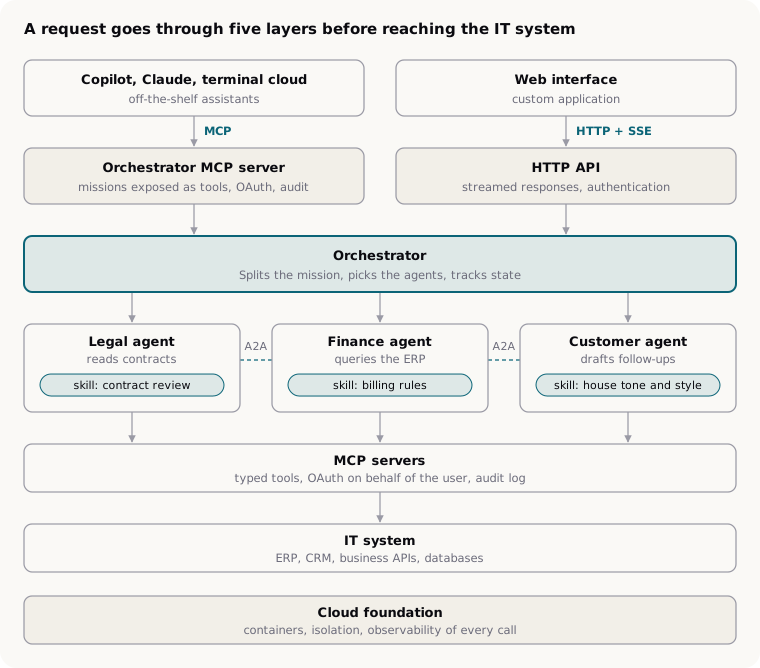
A request goes through five layers. Let’s walk through them quickly.
The interface: you just ask
The user states an intent in plain language. The interface captures two things: what they want, and who they are. Two scenarios:
- An existing assistant (Copilot, Claude, a cloud terminal): the orchestrator is exposed as an MCP server. It shows up as a simple tool, with nothing to build on the interface side, and OAuth and audit come built in.
- A custom web interface: an HTTP API with streaming (SSE). Simpler, and full control over what is displayed.
The orchestrator: the site manager
It’s the brain. It breaks the mission into tasks, picks the right agents and handles errors. And it knows when to stop and ask a human for approval.
Specialised agents, not one agent that does everything
One agent reads contracts. Another queries the ERP. A third one writes. Each has its own scope, tools and rules. The result: more reliable, easier to test, and less damage when something goes wrong.
And to make an agent work the way your teams do, you give it skills: a folder with your guidelines, templates and scripts, which it loads only when it needs them. MCP gives the agent access to the tools; the skill teaches it to use them your way.
MCP and A2A: the two universal plugs
MCP connects an agent to your tools. The model never sees your secrets: the MCP server calls the API, with the rights of the signed-in user, and every action is logged.
A2A lets agents talk to each other, even when they are built on different technologies. Each one stays a black box: they exchange tasks and results, nothing more.
Both protocols are now hosted by the Linux Foundation. For an IT department, that is a strong signal they are here to stay.
The cloud foundation: run, isolate, observe
Containers to absorb the load. Isolation for sensitive data. And above all, observability: every call, every decision, every euro spent must be visible.
The takeaway
The model changes every six months. The architecture stays. That is where to invest.